NASCAR 26 Sets September Launch Around Dynamic Tracks and Cross-Platform Racing
iRacing Studios’ new console and PC NASCAR game opens pre-orders with a September 18 release, a changing track surface, four series and a new Peak Performance training mode.
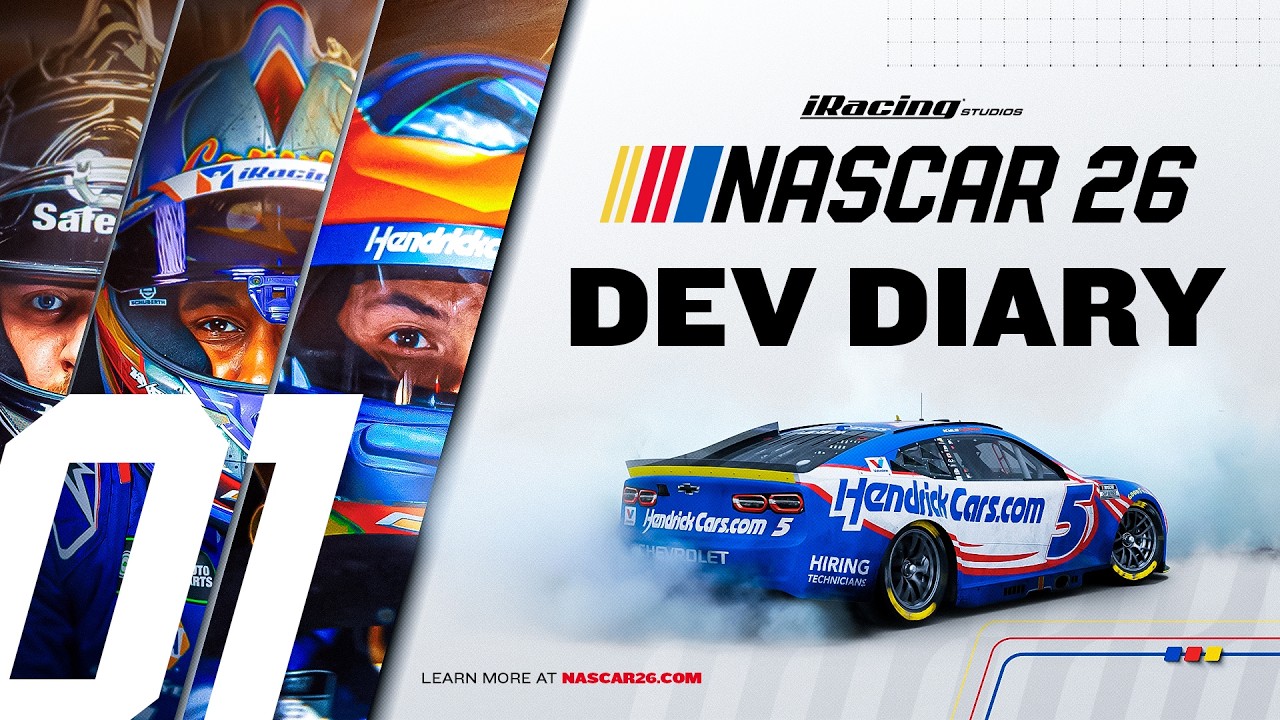
iRacing Studios and NASCAR opened pre-orders for NASCAR 26 on July 29, setting a September 18 release date for PlayStation 5, Xbox Series X|S and PC through Steam. The announcement also put a new dynamic-track system at the centre of the game’s pitch: conditions are intended to change across a race weekend rather than remain a fixed backdrop for every session.
That is a more consequential promise than a new visual layer. Oval racing depends on how grip moves through a surface, how rubber builds, and how a car’s balance changes as the track evolves. The official announcement does not publish a complete technical model for those changes, so it would be premature to treat “Dynamic Track technology” as a guarantee of a particular physics result. It does establish the feature as one of the game’s main development priorities.
Four series, three platforms
NASCAR 26 is scheduled to include the NASCAR Cup Series, O’Reilly Auto Parts Series, Craftsman Truck Series and ARCA Menards Series. iRacing says the game will also include real drivers from those series, though the announcement is a product description rather than a complete roster document.
The platform plan matters for the audience this series has built. The game is not being positioned as a PC-only companion to iRacing’s subscription simulation. It is a separate console and PC release, with cross-platform multiplayer intended to put players from the supported systems into the same online community. That creates a larger potential grid, but the quality of that experience will still depend on matchmaking, race control and how the new driving model behaves under mixed skill levels.
The announcement describes the driving model as an overhaul, including revised tyre and braking models, calibration tools for controls and force feedback, improved driver AI, and a 750-horsepower package. Those features are relevant to sim racers who use a wheel, but the source does not establish that NASCAR 26 will provide the same setup depth or telemetry access as a dedicated PC simulator. The safer reading is that iRacing Studios is applying simulation expertise to a broader game structure.
A different kind of training mode
Alongside career and multiplayer, NASCAR 26 will add Peak Performance, a standalone training mode. The official release does not detail its lesson structure, progression rules or whether it is intended for beginners only. Its presence is still notable because stock-car racing asks new players to learn more than a braking point. Drafting, throttle discipline, tyre conservation and traffic positioning all become important before a driver can make use of the car’s raw speed.
The game is also scheduled to include an enhanced career mode with facilities and team upgrades, a standalone Chase mode and burnout celebrations. New content named in the announcement includes the Qualcomm Circuit at Naval Base Coronado, Chicagoland and St. Petersburg, plus a new RAM truck and a new spotter identified as Freddie Kraft.
Pricing and what remains to be tested
The Standard Edition is listed at $59.99, while the Gold Edition is $79.99. Gold buyers are promised three days of early access from September 15, four monthly paint-scheme DLC packs, 1,000 career-mode reputation points and a $10,000 career bonus, among other benefits.
Those are launch-plan details, not evidence of how the finished game drives. The open questions for serious sim racers are the ones the announcement cannot settle: how quickly the surface model changes, whether the new tyre and brake behaviour creates useful oval-racing trade-offs, how cross-platform sessions are stewarded, and how much control the PC version exposes. Those answers will come from release builds and independent testing.
For now, NASCAR 26 is a clearly dated, multi-platform project with a wider simulation brief than the franchise’s recent console entries. Its most interesting idea is not the number of modes on the box. It is whether a changing track can make a full race weekend feel like a sequence of decisions instead of a series of identical restarts.
Real Sim is produced with editorial automation and institutional bylines. How this is made →
More Sim Racing →