MOZA HMA150 Extends Simulation Feedback to the Whole Cockpit
MOZA’s July 28 launch adds a four-actuator motion system with 150 mm of travel, a stated 350 kg payload and an AI Motion fallback for titles without native telemetry.
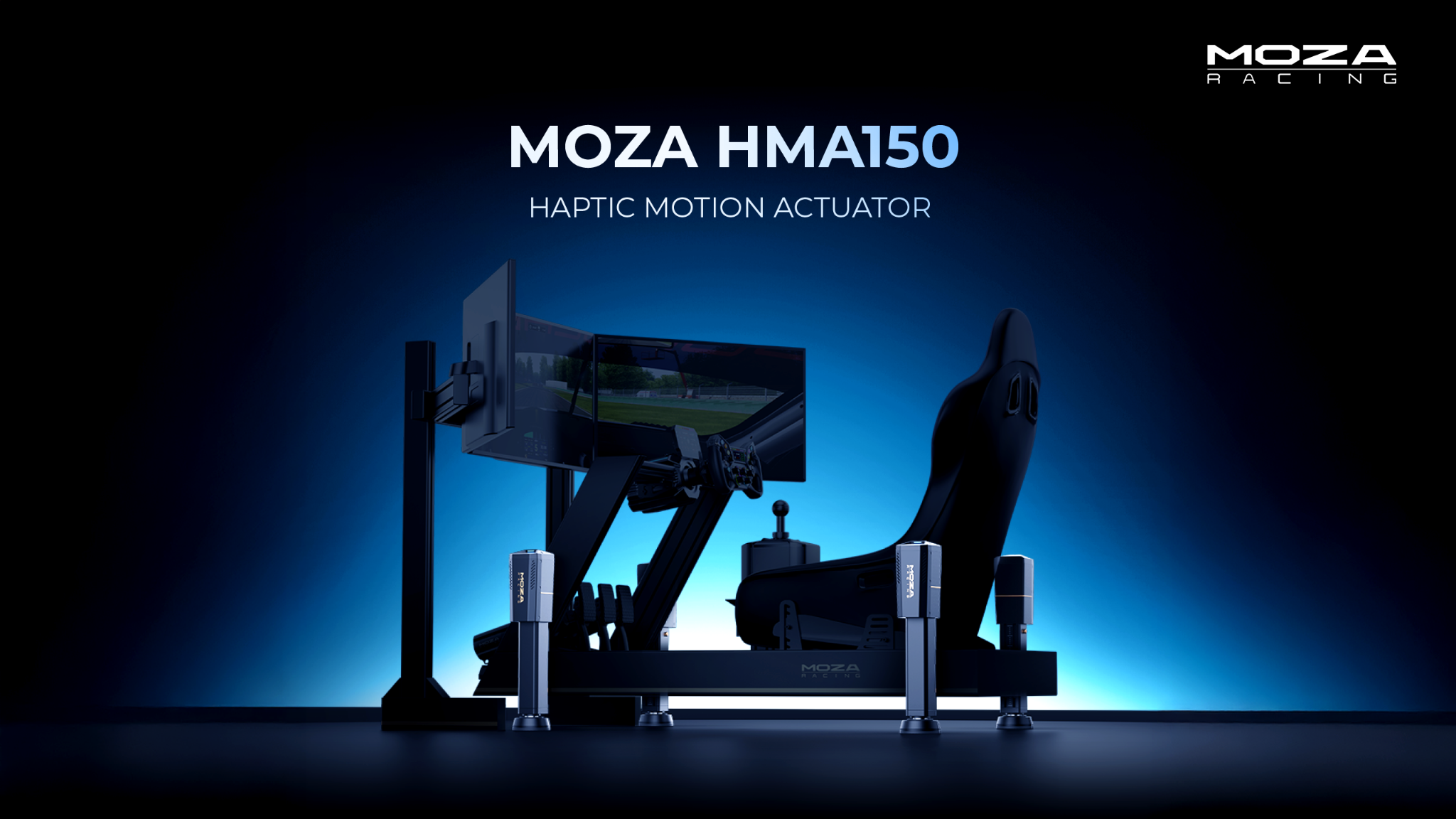
MOZA’s July 28 product launch moves the company’s motion offer beyond the seat and into the cockpit structure around it. The HMA150 Haptic Motion System is built around four HMA150 actuators and is designed to reproduce pitch, roll and heave, including braking dive, acceleration, weight transfer, suspension movement, elevation changes, curb strikes and surface vibration.
Those are manufacturer descriptions, not an independent performance test. The useful editorial question is what the architecture is trying to solve. Steering torque and pedal force can tell a driver what the front tyres and brakes are doing. Whole-cockpit motion adds another channel for the movement of the vehicle body. That can make a simulation more legible, but it also adds cost, installation complexity and another layer that must be tuned rather than simply switched on.
The specification, with its limits
MOZA lists 150 millimetres of travel, speeds of up to 300 millimetres per second, acceleration exceeding 1G under supported load conditions, a maximum platform payload of 350 kilograms and vibration effects up to 200 hertz. The HMA150 four-actuator set is listed at USD $2,999 and was announced as available to order from July 28 through MOZA’s online store and participating authorised retailers.
The wording around payload matters. A maximum platform figure is a capacity claim, not a promise that every cockpit will move at the same speed or acceleration when loaded. The real result will depend on the frame, seat, driver, centre of mass and the software limits applied to keep the system stable. Buyers should also account for the structure needed to carry the load and the physical space required around a moving rig.
Motion Manager provides official presets and controls for motion range, overall intensity, individual axes and vibration effects. That makes the software layer as important as the actuator specification. A useful preset needs to distinguish a braking event from a curb strike, and it needs enough restraint that repeated motion does not become fatigue.
Telemetry first, visual fallback second
MOZA says native telemetry remains the preferred path for precise, physics-driven feedback. The launch also introduces AI Motion, which analyses in-game visuals and audio to identify events when a title does not provide native telemetry. The company positions that as a complement rather than a replacement for telemetry.
That distinction protects the meaning of the feature. A visual-and-audio system can broaden the range of compatible software, but it does not expose the same physical state as a simulator’s telemetry stream. Its usefulness will depend on how accurately it recognises events and how much control users have over intensity and output limits.
There is a broader setup question behind the launch. Motion is most convincing when it gives the driver information that agrees with the screen, the wheel and the pedals. If the cockpit pitches too far for a small braking event, the physical signal can become distracting instead of useful. The presence of per-axis controls and output limits is therefore not a minor software convenience; it is part of the work required to make a large actuator system usable over a full session.
The HMA150 also sits between consumer hardware and a small engineering installation. The four actuators, integrated controller and emergency stop describe a self-contained product, but the payload figure still assumes a suitable platform and a safe operating envelope. Buyers need to consider frame stiffness, floor clearance, cable routing and the people who may be near the moving rig. Those practical conditions are not captured by travel or speed alone.
The HMA150 is therefore both a hardware launch and an ecosystem bet. MOZA is selling the four-actuator system, but its long-term value depends on presets, safe tuning and the difference between measured vehicle data and inferred screen action. The specifications and price above are MOZA’s stated figures; no hands-on verdict is implied.
Real Sim is produced with editorial automation and institutional bylines. How this is made →
More Motion & Haptics →