Sim-Lab DDS TorqueSync Wheelbases Target High Torque Without a Closed Rim Ecosystem
The new DDS26 and DDS39 bases are listed at €1,499 and €1,999, with 26 Nm or 39 Nm of peak torque, USB wheel connectivity and a 100 kHz feedback loop.
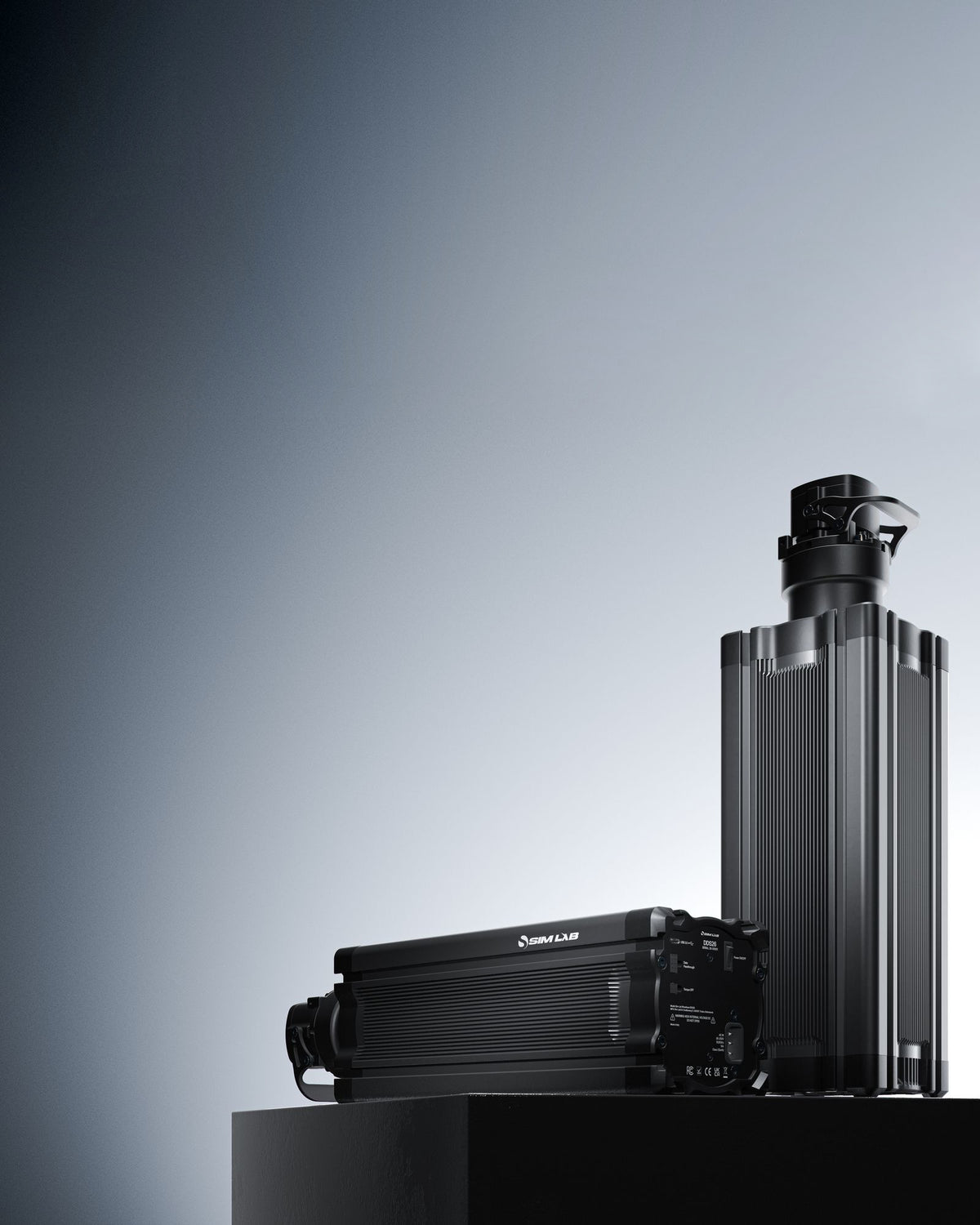
Sim-Lab is presenting two new direct-drive wheelbases under its DDS TorqueSync name. The company’s product page lists the DDS26 TorqueSync at €1,499 and the DDS39 TorqueSync at €1,999, with peak-torque ratings of 26 Nm and 39 Nm respectively. Both bases are described as open-ecosystem hardware intended to work with USB steering wheels rather than locking the buyer into one rim family.
The product page is a manufacturer specification and sales presentation, not an independent performance test. Its claims about force-feedback feel, latency and motor response should be read as design targets until the bases are available for third-party measurement. The more concrete story is the combination of torque, connectivity and mounting options Sim-Lab is choosing to put into the product.
The open-ecosystem pitch
High-torque bases often become the centre of a cockpit ecosystem. A wheelbase can be mechanically compatible with many rims while still narrowing the practical choices through proprietary quick releases, power limits or software dependencies. Sim-Lab says the DDS platform supports USB steering wheels, provides data passthrough and includes auxiliary channels and a dedicated power line.
That approach is aimed at buyers who already own a rim, button box or flight-control accessory and want to choose a base without replacing every component. The company’s product page also describes a new Xero-Play quick-release in which the primary mechanism stays on the base and wheel-side adapters are simpler. The claimed benefit is a lower cost for adding more rims, though the page does not provide a complete adapter price list.
Installation is treated as another part of the platform. Sim-Lab says the housing includes precision slots on all four sides and supports side, front and bottom mounting. Front mounting is particularly relevant to rigid racing cockpits, where a bracket that flexes under high force can become the limiting component. A base specification cannot prove that a complete rig will be rigid enough; the cockpit, mount and wheel all remain part of that mechanical chain.
What TorqueSync is supposed to change
Sim-Lab describes TorqueSync as a patented signal-translation system that synchronises simulation updates with the servo drive at up to and above 100,000 times per second. The company links that loop to lower-latency force output, sharper transient detail and more stable control near the limit.
Those are engineering claims, not a guarantee that every simulator or force-feedback profile will feel the same. The frequency of an internal control loop does not by itself establish total end-to-end latency, which also depends on the game, telemetry path, driver, filtering and motor. It is still a meaningful design choice because Sim-Lab is exposing the control architecture as part of the product’s identity rather than selling only a peak-torque number.
The page also lists an internal 350-volt operating architecture, a 1,500-watt integrated power supply and a 24-bit encoder. Those components help explain why the bases occupy a high-end price bracket, but they also raise practical questions around installation, electrical requirements, thermal behaviour and safe use. None of those questions can be answered by the product page alone.
Two models, one decision
The DDS26 is positioned as the core model for GT and open-wheel driving, while the DDS39 adds more peak torque for buyers who want greater headroom. More torque is not automatically more realism: a driver still needs a suitable wheel, a rigid mount and a force-feedback profile that can be used safely.
The important change is Sim-Lab’s move into a category where ecosystem decisions matter almost as much as motor output. If the USB connectivity, mounting flexibility and quick-release approach work as described, DDS gives existing cockpit owners a way to add a high-torque base without treating the rest of the rig as disposable. Independent testing will have to establish how closely the claimed control response translates to the driver’s hands.
Real Sim is produced with editorial automation and institutional bylines. How this is made →
More The Hardware Deck →