XCEL ITECH’s KLAV27 Puts a Collaborative Rail Simulator Into Service
Malaysia’s first collaborative train-driving simulator recreates the 46.4-kilometre Kelana Jaya Line and lets several operators practise coordinated and emergency scenarios together.
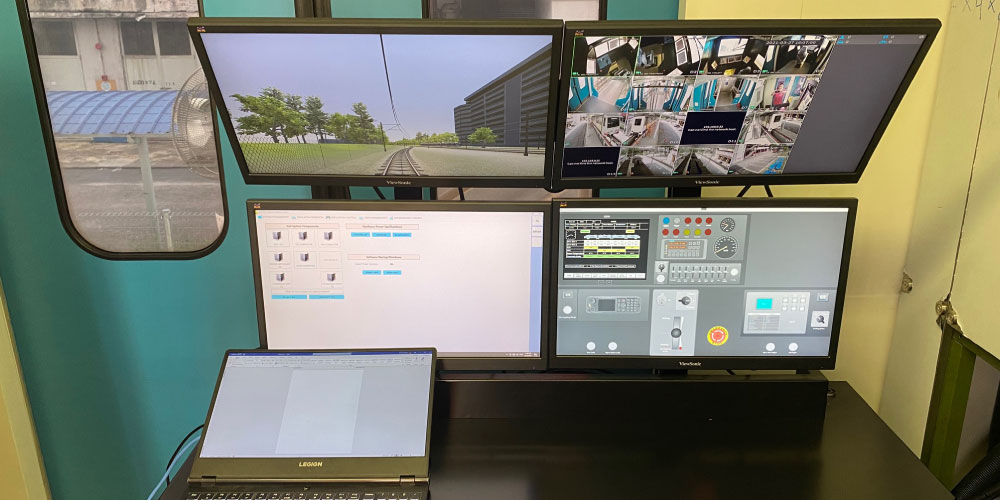
XCEL ITECH has delivered the KLAV27 Train Driving Simulator to Prasarana Malaysia Berhad, creating a shared training environment for the Kelana Jaya Line. The handover, announced on July 29, 2026, is described by the partners as Malaysia’s first collaborative rail training simulator.
The important word is collaborative. Traditional driver simulators often place one trainee in a cab and evaluate that person’s response to a route or fault. KLAV27 is designed to let several operators practise together inside the same virtual railway environment. That makes it possible to work on coordinated train movements, communications, disruptions and emergency responses before those situations are encountered on the live system.
The simulator recreates the 46.4-kilometre Kelana Jaya Line, including all 37 stations and one depot. A route replica at that scale is useful for more than memorising the order of platforms. Drivers can learn the relationship between signals, stations and operating constraints, while instructors can introduce a scenario at a known location and compare how several trainees respond to the same problem.
XCEL’s own train-simulator architecture explains how that work can be organised. Its instructor operating station can manage route selection, environment settings and real-time guidance, create and replay obstruction, intrusion and failure scenarios, and monitor simulation status. The company also describes an observation station with after-action review tools that display trainee conditions, signals, signs, switch states, faults, events and the current route.
Those tools shift the value of a rail simulator away from visual immersion alone. A realistic view through a windscreen is useful, but operational training depends on what happens around the driver: how a second operator communicates, how an instructor injects a failure, how a decision is recorded and how the team reviews it afterward. The shared environment gives the operator and the training organisation a way to examine those interactions rather than treating every exercise as an isolated lap.
The project was developed under Malaysia’s Industrial Collaboration Programme with the Alstom Transport Systems Malaysia and Hartasuma Consortium, the Technology Depository Agency Berhad, Prasarana and XCEL ITECH. That partnership is significant because the simulator is tied to a specific public-transport operation rather than being a generic product demonstration. It also places a local technology company inside a capability-building programme focused on transfer of knowledge and industrial development.
There are limits to what the announcement establishes. It does not publish the simulator’s certification basis, the exact number of connected trainee stations or a timetable for how Prasarana will integrate it into every training course. Those details matter to operators and regulators. The handover does establish the intended use: a controlled virtual railway in which teams can rehearse normal operations, faults and emergency coordination without occupying the live line.
KLAV27 is a useful reminder that simulation news is not only about consumer games and cockpit peripherals. In rail, the hard problem is often shared context. A driver’s decision can affect a line, a control room and other trains at the same time. A simulator that lets several people practise that relationship together is closer to an operational rehearsal than a solo driving exercise, and that is why this delivery matters.
The distinction has consequences for how the device should be evaluated. A train simulator can reproduce a route convincingly and still fail to teach the habits an operator needs if it cannot represent timing, communications and the consequences of a fault. Conversely, a less spectacular visual scene can be valuable when it gives the instructor control over the event and produces a clear review record. KLAV27’s published architecture is aimed at that second problem: making the exercise observable and repeatable.
For a public transport operator, repeatability is also a way to standardise learning across crews. The same disruption can be introduced at the same location, with the same operating constraints, and then discussed without exposing a live service to the experiment. The handover does not publish outcome data, so it is too early to claim a training benefit. It does show a simulator designed around the operational relationships that training organisations need to rehearse.
Real Sim is produced with editorial automation and institutional bylines. How this is made →
More Other Machines →