ELITE S923 Simulator Heads to Turkish University for Multi-Crew Training
Eskişehir Technical University has taken delivery of an ELITE S923 FNPT II MCC after an international tender, adding a convertible platform for instrument, crew and airline-oriented instruction.
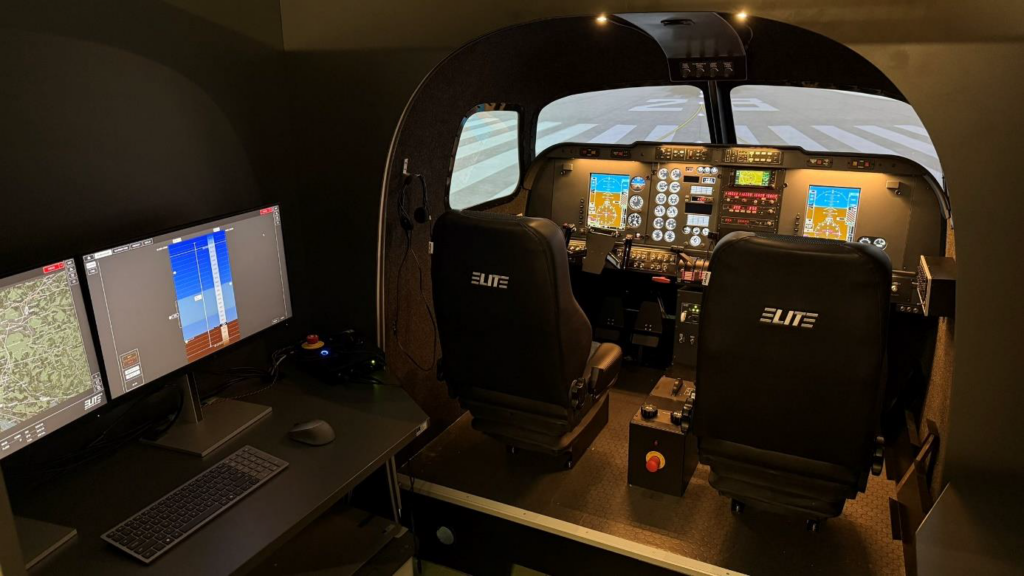
ELITE Simulation Solutions announced on July 30, 2026 that it had installed an S923 FNPT II MCC simulator at Eskişehir Technical University in Turkey. The university selected the platform through an international tender involving several flight-simulation providers, giving its aviation programmes a new device for both academic instruction and professional pilot preparation.
The S923 is designed as a convertible training platform rather than a single-aircraft display. ELITE describes a King Air B200-based system that can support single-engine and multi-engine operations, with advanced avionics integration, dynamic control loading, glass and analogue cockpit configurations and an instructor operating environment. The company says the platform is designed to comply with EASA FNPT II MCC qualification standards while also supporting multiple international certification pathways.
That flexibility is relevant to a university because the training problem changes as a student progresses. Early exercises may focus on instrument procedures and navigation. Later sessions can require two people to share tasks, communicate clearly and respond to a failure without losing the aircraft’s wider state. A convertible device can be useful when the institution needs more than one cockpit identity but does not want every course to require a separate full-size simulator.
ELITE lists the installation’s intended training scope as Multi-Crew Cooperation, IFR procedures, navigation exercises, crew coordination, abnormal and emergency procedures, airline preparation and advanced procedural work. These are categories of instruction, not evidence that every course or credit is automatically available on day one. The effectiveness of a certified training device still depends on the approved operator, instructor, course design and the procedures used around it.
The university’s setting makes the installation notable. Eskişehir Technical University operates aviation and aerospace programmes, a training fleet and Hasan Polatkan Airport, alongside maintenance and control-simulation facilities. A new multi-crew device can connect classroom knowledge to a more structured cockpit workflow, while the school’s existing aviation infrastructure gives students a route from procedure practice toward live operational environments.
The S923 product architecture also leaves room for future configurations. ELITE says the system can be scaled and adapted as training requirements change, which is a different proposition from a consumer cockpit that is upgraded primarily for visual detail. In professional training, the important question is whether the hardware, avionics, flight model and instructor tools remain aligned when the simulated aircraft or course changes.
There is no substitute here for independent assessment of the device or for the university’s own training outcomes. ELITE’s announcement establishes the delivery, the tender and the platform’s stated scope; it does not publish utilisation figures, student results or a detailed timetable for certification and course integration. Those boundaries matter when a manufacturer announces a new installation.
The immediate significance is still clear. A university has added a convertible, certification-oriented simulator at a time when pilot training programmes are under pressure to provide more structured multi-crew experience. The S923 is not being presented as a game accessory. It is infrastructure for repeating complex procedures safely, reviewing crew decisions and building habits before those decisions carry the cost and risk of a live aircraft.
The convertible format also changes the economics of curriculum design. A school can use the same instructor workflow while changing the cockpit logic, avionics arrangement or crew task being rehearsed. That does not make the training interchangeable: each aircraft configuration still needs appropriate procedures, lesson plans and instructor knowledge. It does give the institution a common physical and software base from which those differences can be taught, assessed and repeated.
That repeatability is the central value of an FNPT II MCC device. A lesson can be paused, reset and discussed without the noise of a live flight, while the crew can concentrate on communication and task sharing instead of merely keeping the aircraft airborne. In a university environment, that makes the simulator a bridge between technical subjects and operational judgement. The installation will be most useful if students meet its limits as clearly as its capabilities.
Real Sim is produced with editorial automation and institutional bylines. How this is made →
More Beyond the Game →